Role
In-game leader
Calls the strategy, reads the opponents and decides how to spend money. Often not the top fragger.
Watch for mid-round calls that move the whole team at once.
Five Terrorists (T) try to plant the bomb (the C4) at bomb site A or B. Five Counter-Terrorists (CT) try to stop them or defuse it.
Eliminate the other team, explode or defuse the bomb, or (as CT) run the clock out. A round lasts 1 minute 55 seconds; a planted bomb explodes after 40 seconds.
A map is won by the first team to 13 rounds (this is called MR12). Teams swap sides after 12 rounds.
At 12–12 the map goes to overtime: blocks of six rounds, first to four. If it’s level again, another block starts.
Every round both teams earn money and buy guns, armour and grenades. When and how to spend is a big part of the game.
Big matches are best of 3 maps, finals best of 5. Teams ban and pick maps from a pool of seven before the match (the veto).
Valve sets the competitive pool, called Active Duty. These are the seven maps being played at the PGL Major Singapore 2026. Compared with the Cologne Major in June, Cache is in and Overpass is out.
Bomb sites: A/B
Bomb sites: A/B
Bomb sites: A/B
Bomb sites: A/B
Bomb sites: A/B
Bomb sites: A/B
Bomb sites: A/B
Map pool from the maps played at the Singapore Major (results via Liquipedia and HLTV).
Counter-Strike is as much about money as about aim. Every team member also has a job.
Everyone starts each half with $800 and a pistol. Winning it gives you a head start on money.
Rifles (AK-47 for T, M4 for CT), armour, a defuse kit for CTs and a full set of grenades.
After a loss, a team might save (an eco) to afford a full buy next round, or force-buy cheaper guns with everything it has.
Losing in a row pays more each time, so a team that keeps losing can still buy rifles. Money is capped at $16,000.
Calls the strategy, reads the opponents and decides how to spend money. Often not the top fragger.
Watch for mid-round calls that move the whole team at once.
Uses the AWP, the sniper rifle that kills with one body shot. Expensive, so the team often saves money for it.
Watch for the opening pick that starts a round 5 against 4.
First through the door on T side, trading their life for space and information.
Watch for who goes in first when the smokes land.
Throws the grenades that let others take a site, or holds a site alone on CT side (the anchor).
Watch for the player stuck on a bomb site who has to delay three attackers.
Plays away from the team to catch rotating opponents or stop flanks.
Watch for a lone T player on the far side of the map.
Role names are informal: teams split jobs differently, and many players switch between them.
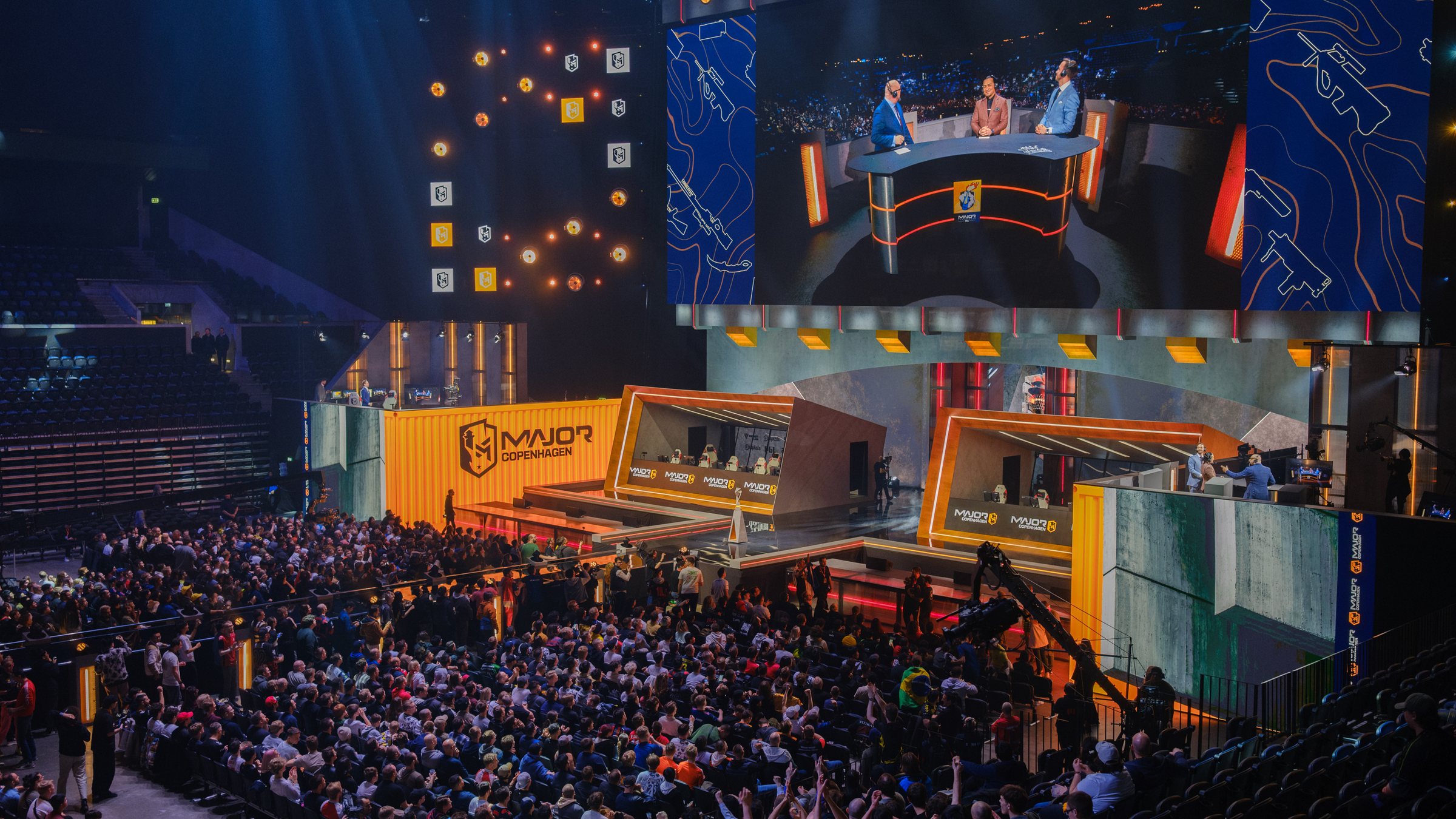
Valve doesn’t run a league. Independent organisers (ESL, PGL, BLAST and others) run tournaments all year. Twice a year one of them hosts a Major, sponsored by Valve: the most important events in Counter-Strike.
A Major has three 16-team Swiss stages: three wins and you go through, three losses and you’re out. The best teams are invited straight into Stage 2 or Stage 3.
Eight teams play single-elimination playoffs in an arena: best of 3, with a best-of-5 grand final.
Valve’s official ranking, published on GitHub, built from match results. Organisers use it to decide which teams are invited and at which stage they start.
The best-known media ranking, published weekly by HLTV. Our CS2 roster tracker follows the HLTV top 20.
IEM Cologne Major (June), won by Team Falcons 3–0 against FURIA, and the PGL Major Singapore (24 November – 13 December), happening now.
FiRe Major Buenos Aires (31 May – 20 June) and the Perfect World Shanghai Major (22 November – 12 December).
Sources: ESL FACEIT Group, PGL, Perfect World, Valve’s counter-strike_regional_standings repository on GitHub, Liquipedia and HLTV.
Tap a card for a little more. 25 terms.
ISTL Esports explains esports for people who are just getting started. League of Legends is still our home: read the LoL guide. For CS2 we cover the biggest events and roster news, always with sources.